
Navigating Holiday Overwhelm by Caring for Your Inner Parts
This week I sat by my Christmas tree with a cup of tea and took in the decorations. There's one from my grandfather’s old tree, some indestructible plastic baubles from when my son was two and attacking everything with his pirate sword, ornaments from travels, from friends, from different chapters of life. It's a small ritual that brings me genuine joy - the smell of pine, the lights in the early darkness.
And yet this same season also brings moments of sheer overwhelm. There's the pressure of getting everything done before year-end, the weight of family expectations, the grief that surfaces around losses that feel more acute in December.
The holidays can be paradoxical like that - holding both the giddy, childlike delight and something much heavier at the same time.

A good friend reminded me recently to tend to my protector parts.
I'd been talking about everything that needs to happen this December and sharing my holiday overwhelm - and she did for me what I do for others - helped the helper. The irony made me smile.
It was good timing. Because this time of year is when those parts tend to get loudest...
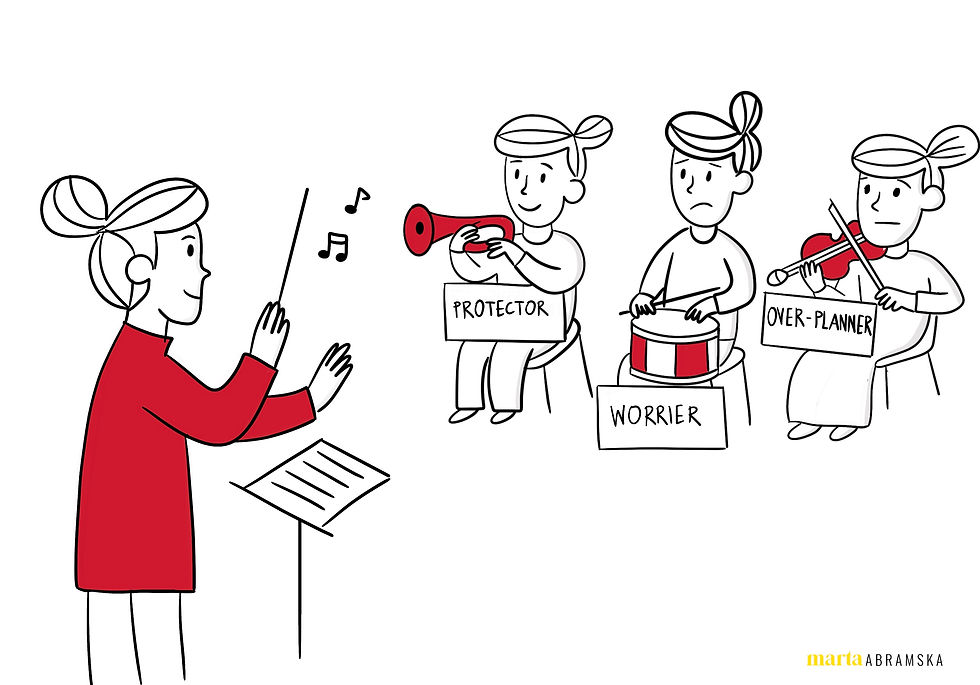
In Internal Family Systems language, protector parts are the aspects of us that manage emotional intensity and prevent us from feeling vulnerability - the strategies we developed, some of them earlier in life, to help us stay safe and functional. When we are centred and present, these parts tend to settle. But when we move closer to something tender, uncertain or painful, they step in to shield us in the best way they know how.
Almost like little elves at Christmas - except instead of making toys, they're busy trying to keep us functioning.
December brings more of everything - more people, more expectations, more sensory load, more relational history compressed into a short window of time. Family dynamics stir up old patterns, even if we feel relatively steady in adult life.
Some of our protectors may be "young parts" still using old strategies - child-like protectors may aim to please or seek approval, or teenage protectors may rebel, shut down or become sharp.
We all have protector parts, and they use different strategies depending on the person.
Here are a few patterns - I wonder if you might recognise some of them?
There's the over-planner - the part that holds the world record for the longest to-do list and the biggest cognitive load, playing out the most complicated chess game to make sure everything comes together for Christmas. Its mantra: if everything is planned, nothing can go wrong.
Control equals safety.
But underneath all that organisation is often anxiety about disappointing people, or fear that if we’re not managing every detail, something important will slip through the cracks and it will be our fault.
Then there's the over-giver. This one shows up believing that generosity will keep relationships smooth. It says yes to hosting even when we're exhausted, buys more gifts than we budgeted for, takes on everyone else's emotional weather, offers help we don't actually have capacity for. It learned somewhere along the way that our worth comes from what we can give, and December - the season of giving - puts this part into overdrive.
And there's the one with a short fuse. The part that snaps at a family member over something small, reacts sharply when interrupted, or suddenly can't bear one more request. It doesn't mean to be unkind - it's actually trying to protect us by creating space, fast, because our system is overloaded and doesn't know how else to signal "stop." This one often makes us feel terrible afterwards, which can make it even harder to recognise as protection rather than personal failing.
So what do we do with this awareness?
These parts don't need fixing - they need inner leadership - someone steady to meet them. When we connect to them from our centred self, approaching with curiosity rather than pressure, with kindness rather than judgment, they tend to relax.
They usually welcome a bit of appreciation too.
Here's what I'm reminding myself to do this December, and an invitation to consider it for yourself:
Notice the parts that show up and meet them with warmth
When these protector parts appear, they're usually signalling that something in us feels a bit too much, too fast, too familiar or too uncertain.
It's a moment to pause and recognise that a part of us is taking over - and to remind ourselves that we are not that part. When we're able to make that distinction, the part often softens. What might we need in that moment? The protector that makes us snap when overwhelmed is often signalling that we need a few quiet minutes alone, a slower breath, a sense of privacy or calm so the system can reset. The over-planner may be signalling that we need some help, or simply a moment of not being responsible for everything. When we acknowledge these parts with genuine kindness rather than judgement, they tend to settle. Warm, curious attention is often enough for the system to shift.
Set boundaries that let your protectors rest
Protectors often work overtime because they don't trust that anyone else is managing capacity. When you - the centred, adult self - take responsibility for what you can and cannot hold, they don't have to work quite so hard. This might mean saying no to an invitation, leaving the party early, asking someone else to bring dessert, or deciding the cookies can be shop-bought this year.
You know best what boundaries will honour your values and protect your capacity.
Shift from performance to presence
Your protectors - including that inner critic voice that gets particularly loud at Christmas - are often trying to make sure you're doing it right. Good enough as a parent, generous enough as a partner, creating the kind of Christmas that matters. The bar keeps rising, and it's exhausting. What if you let go of orchestrating a great experience and simply showed up for the one that's actually happening? Enjoy a slow taste of that mince pie without making a plan for how to burn it off afterwards, go proud with the crumpled gift bag that you're using for the third year in a row, enjoy the silly conversations or bickering about politics, whatever arises. When you stop judging yourself against that internal standard, your protectors can finally rest too.
Not all of our inner world is made up of protectors working overtime. When those protectors feel acknowledged and begin to settle, other parts of us often become more available - the younger ones who genuinely enjoy this season. Some of them love the lights, the music, the silliness, the treats, the familiar traditions. Others might need comfort, quiet or reassurance. Meeting these younger parts with curiosity and warmth matters. There's room for both the work of tending to our protectors and the simple delight of reconnecting with the parts of us that still find a bit of magic in December.
Would you like to work with your own inner landscape? Let me know – I'd be happy to explore it with you. Simply email me at coaching@martaabramska.com
Wishing you an end of the year that honours all of your parts!


Comments