
The Patterns We Come Back To After Summer: Leadership Under Pressure
I was walking the dog this morning, the first morning my son went back to school, and I had a distinct sense of something ending and something beginning, a sense of crossing a threshold.
That back to school feeling.
When I was a teenager, choosing the right notebooks and pens was my sacred ritual. My friends laughed at me for having to check every shop in town before committing to a new set that felt just right.
Partly this was the love of stationery, which is still very much alive in my 40s.
But those new notebooks always came with something else attached: the feeling that this time I was going to do things so much better than last year. Become a perfect student - organised, consistent, on top of things.
Yet then the same thing happened each year. Within days I'd slipped back into being the person I actually was - a bit rebellious, independent-minded, with pages out of order and doodles in the margins. I did well at school. I was just never that kind of perfect student.
Walking in the cooler air, I smiled as I noticed that old part of me showing up while thinking about my priorities for this autumn. The part that wants to be a better version of herself.
And of course, I now know the shiny new notebook isn't the answer.

What we bring back
It made me think about how often we carry that same hope into other fresh starts: that with a little more discipline and better habits, this time things will be different.
But here is something I've learned about sustainable change over years in my coaching practice. The first step is clarity and motivation. But the next, crucial part of the work happens when we're back in the conditions that made our old ways of operating feel necessary in the first place.
Many of my clients have had a chance to switch off over the summer, even if that switching off may not have been easy to start with. Perhaps you checked your email for the first few days even though you said you wouldn’t, or it took a while for your body to settle into rest, and initially you felt flat rather than restored.
But then, once your body had a chance to relax - maybe just a few days before going back, surrounded by nature, without anywhere to rush to - things became clearer. What you need, what matters, how you want to lead. And also what you don’t want, or what you’re no longer willing to put up with.
And then, the post-holiday reality might hit like a brick wall: a long list of things waiting for your arrival that now need dealing with immediately.
Back in the regular rhythm of life, with a never-ending list of demands and things to do, the question becomes: how do I keep the promises I made to myself?
Our first instinct is usually a plan
Excellent at getting things done, we often approach this by wanting to take some sort of action.
So we make a plan. Be better at boundaries. Leave on time. Put placeholders in the calendar. Maybe sign up for a class. These are all worthwhile.
In fact, they may be exactly the practical changes we need to make.
But they're more likely to stick when they follow the work of understanding what keeps pulling us away from them.
Without that, they have the same lasting power as that lovely notebook at the beginning of a school year.
Because by the second week back, the effects of the holiday may already be fading, and we might find ourselves operating much as we did before we left.
Too many things on. Everyone else's needs trumping our own. Before we know it, we're back in survival mode because everything is moving so quickly.
There's no shame in that. We all do it, because we're holding so much. Many of my clients are holding demanding roles alongside care responsibilities, and what seemed so clear in August can be harder to make space for now.
And our familiar patterns might be back before we know it
Here's the thing about our patterns: they will surface in certain contexts. They were quieter on holiday because there wasn't much to react to. They could lie dormant while we enjoyed a relaxing day at the beach.
Because our familiar ways of responding will win against a calendar placeholder every time.
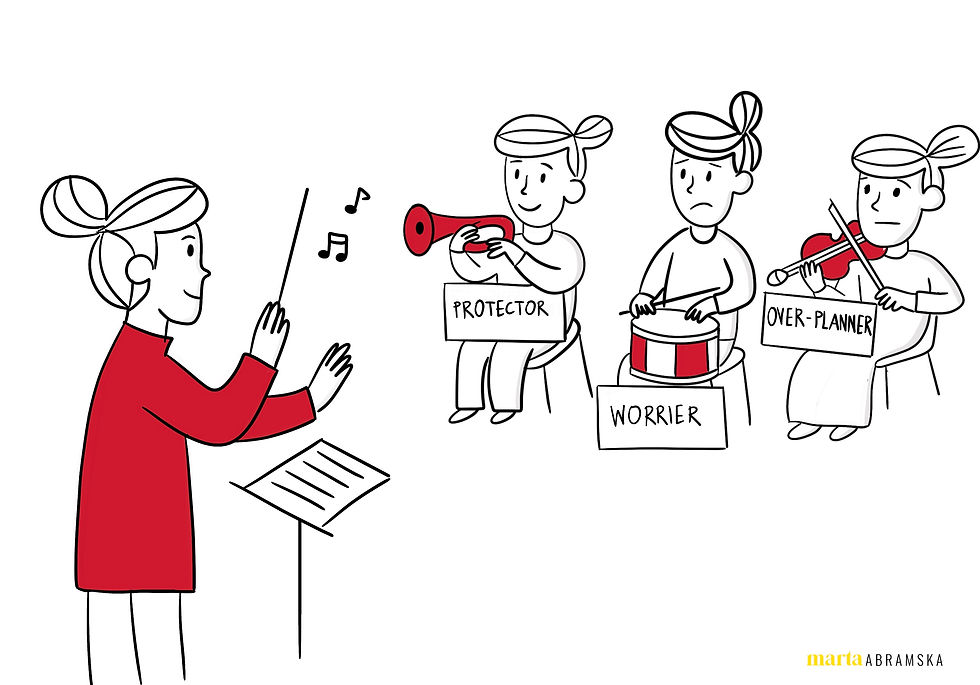
Something worth reflecting on about leadership under pressure is that we each have a fairly small handful of familiar ways of responding when we're under pressure. Familiar ways of managing discomfort.
Take perfectionism as an example
With a little distance, you might see quite clearly that not everything needs to be done brilliantly, that some things can simply be good enough.
But put yourself back into a high-stakes meeting, a difficult piece of work, or a week when you already feel behind, and doing something really well can suddenly feel necessary again because the conditions that made perfectionism useful to you are back too.
Because that part of us that wants things to be done well isn't just about high standards. It is protecting us from something: the discomfort of being judged, getting something wrong, disappointing someone, or having our competence questioned.
When those possibilities feel real again, the part has a job to do.
An invitation
What if the useful thing to bring back from August isn’t a plan of action, but a little more capacity to notice ourselves when the pressure returns?
If you notice yourself cancelling the class, overriding that calendar hold, or working late, the invitation isn't to have more willpower to "stick to it".
It is to recognise that this is happening with self-compassion.
And then to get curious: What has happened that makes me compromise on what felt important, or even non-negotiable, a few weeks ago?
Sustainable change begins not with becoming better at overriding our default patterns, but with becoming better acquainted with them.
And then we have more choice in how to respond.
Perhaps coming back isn't: This year I will finally be more organised / boundaried / balanced.
But something closer to: This year, I want to get better at noticing what happens to me when things get difficult.
This can include questions like: When does "good enough" suddenly stop feeling good enough? What has just become important? What am I afraid might happen if I don't do this perfectly?
If a break gave you enough distance to see the pattern, being back gives you the conditions to understand how it operates.
Curious to explore what happens to you when the pressure returns, and what understanding those patterns might make possible? This is exactly the kind of work we do in coaching to create lasting change.
I’d love to hear from you.


Comments